Max Allen Validates the way BWU$20 assesses wines


This is how Max starts a recent piece titled Take some time over your wine in the Australian’s Executive Living section:

WHAT a difference a day makes. I tasted half a dozen new Australian grenaches recently, all from the Barossa and McLaren Vale in South Australia, all from the very good 2012 vintage. And then I tasted them again, 24 hours later, from the same bottles, so each had had a little exposure to air in the intervening time. And they all tasted different – some a little bit, some quite a lot.

OK, this is not exactly big news. Just about everybody who’s not part of the ludicrous wine judging circus in our country agrees that judging long lines of wines on enormous benches is a dumb idea. Still, it’s good to read it once in a while.

At BWU$20, we assess wines in the same settings you drink wine in: before and over dinner, in restaurants, at picnics and barbeques, with family and friends. The only difference is that we open several bottles to make sure we have some left for a couple of days. The change can be dramatic or barely noticeable. As Max points out: when a wine doesn’t change much over a couple of days in the open bottle, it’s an indicator of longevity.
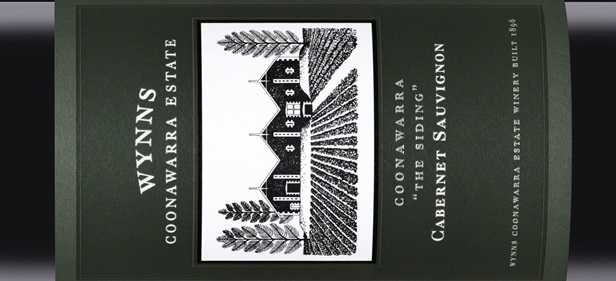
0002738_wynns_coonawarra_estate_the_siding_cabernet_sauvignon_750mlSome wines open up like a peacock’s tail feathers – The Wynns Siding Cabernet 2012 was a recent example of that. Others just fall apart. Max mentions the Yalumba Bush Vine Grenache 2012, which struck us as pretty simple and gutless on opening. Over the next couple of days, we go back to the open wines (reds and whites) and see how they’ve developed.

Another difference is that we focus on drinkability and character. If a wine has both in spades, we don’t mind a few technical faults. Wines like that tend to work well with flavoursome food. By contrast, wine judges jump on faults, and mark wines down for them. That explains why so many bland and boring wines make it through to a podium finish: our judges reward technical perfection, not character or drinkability.

KIM
NZ Sauvignon Blanc – going from bad to worse

Marlborough Men: still trashing their biggest brand

This weekend, Dan Murphy and 1st Choice both had Stoneleigh Sauvignon Blanc on special for less than $9 a bottle. I’ve made no bones about our low opinion about these cheap Kiwis, but I kind of suggested in our Friday bargain Alert that you probably couldn’t go wrong at this price. Then I  thought I’d better grab a bottle of this wine to make sure that was good advice.

Dan Murphy had none left on Saturday morning, such had been the rush on Friday when the deal was pushed out on the web. 1st Choice had a few bottles left so we grabbed one to try on Saturday night. It was rubbish, industrial concoction written all over it: fake hints of tangy gooseberry, harsh acid softened by residual sugar that reminded us of saccharin, and a finish that just went to mush.

Looking for what others said about this wine, we found our own review of the 2012 Stoneleigh, which said: A standard bearer for the oceans of awful Kiwi Sauvignon Blanc being dumped on our shores. This wine gives us a brief a hint of the variety on the nose, before descending into a wishy washy mess on the palate that lacks class and structure and style. Dreadful stuff even at this price.’

More >>

100 point scores – Parker still seduced by overripe Reds


PLUS CA CHANGE

‘Is it a conscious decision by some wine writers to give over-inflated scores? In some cases I believe that it is. Their peers may laugh at them, but why should they care? The people who make and sell wine will be eternally grateful, especially in the current economic climate, when expensive wine is difficult to shift. Consumers want guidance, which is why high scores sell bottles. It’s only a guess, but I think we are going to see a lot more 100 pointers in the future. Whether the wines truly deserve it is another matter.’  Tim Atkin MW

My friend Jeffrey sent me an email this week about a wine dinner he enjoyed at the new Rockpool in Sydney, which he says looks and feels like a funeral parlour. One of the wines served by the importers who hosted the dinner was a 2010 Pontet-Canet, a fifth growth from Pauillac that has been improved dramatically since Alfred Tesseron took over in 1997.

Now this is way out of BWU$20 territory, but Pontet-Canet 2010 gets 100 points from Robert Parker, and it’s half the price of the 100 point Grange 2008 which got the same perfect score from the Parker camp. A genuine bargain, clearly. I mean we’re in rarified territory here, among greats like Château Latour, Le Pin, Cheval Blanc and Petrus who also got perfect scores, and well ahead of Lafite, La Mission Haut-Brion, Ausone and Mouton Rothschild on 98 points. P-C 2009 also scored 100.

More >>

MKR – The Weakest Link in a different setting


These shows follow the same formula: some poor sod’s misfortune is someone else’s gain. I don’t watch this show often, and tonight there was a young couple that had obviously messed up their moment in the limelight.  These two seemed to take real heart from the Cairns couple (the guy looks a bit like Jack Nicholson) making a bigger mess of things than they had apparently.

They weren’t the only ones – there were lots of smug faces around the table. In this bitchy game, one couple’s misfortune is another couple’s gain. There was the stuck up-blond princess sitting with her sour-faced mum announcing after the main course that she wasn’t worried that her expectations would be superseded by the dessert. I’m not sure what the others made of that, but we know what she means don’t we?

She’s a first class bitch, and I hope she gets her just desserts real soon. And we offer the same wishes to the rest of them. What a horrible bunch of people – are they getting nastier with every cycle of MKR, because that’s what the producers are pushing for? Because NASTY and BITCHY are good for the ratings?

This evening did offer a lesson to aspiring foodies though: Presentation is a major key to success. The first two dishes were disasters. Our friends from Cairns had given no thought to colours and textures, and ended up with yellows and browns supporting off-white and cream colours.

Their dessert looked terrific but sadly no one liked the taste of it, so they all bitched about it. The only plus was a complete absence of black wine glasses.

Frankly, most of these people deserve to be tossed into the Cook’s River. Sorry, but the pun was intended. The river is a cesspit, and inflicts great shame on the councils and the people in the surrounding suburbs –  Ashfield, Bankstown, Canterbury, Hurstville, Marrickville, Strathfield and Rockdale.

img_53121

Kim

My Kitchen Rules with Black Wine Glasses

I watch a bit of MKR from time to time just to see how silly it gets, but only when my partner is busy doing something else – she thinks it’s the pits which it is. Funny that: usually women have a fascination with horrible stuff like TV shows with gruesome murders, so you’d think MKR would be right up their alley.

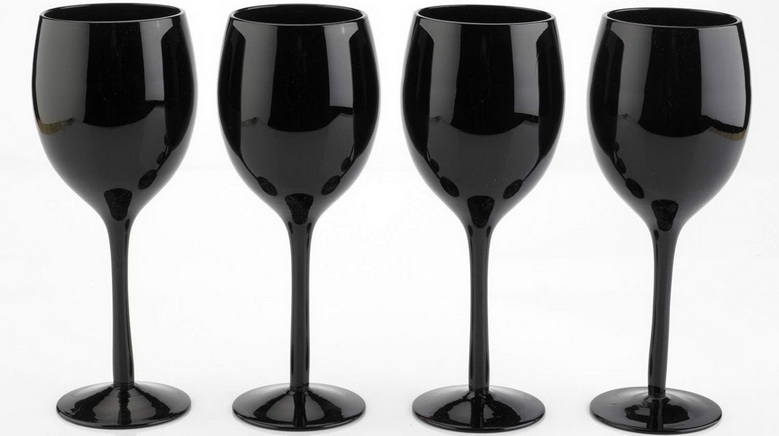
Anyhow, the other night we got the sweep photo of the pop-up restaurant before the guests sat down, and I was flabbergasted (thanks, Rex Mossop) – to see black wine glasses on the table. Now come on, how cool is that? No, it’s beyond cool, it’s sick!

black-elegant-wine-glasses I think it was the same night that several of contestants said they had trouble with an item on the menu: Chateaubriand. And others asked what Stilton cheese was. I’m sitting there thinking: and these guys are supposed to be foodies? They have no idea about Chateaubriand, and they’ve never come across Stilton cheese? And they serve wine in black glasses?

How can you be a foodie and not have the faintest notion about serving wine? You’d have to be a bogan. What kind of wine would you serve in black glasses? The black wines of Cahors? No, you need a contrast colour, right? Mattheus Rose? No, the colour isn’t strong enough. How about Bailey’s Irish Cream? Now we’re onto something.

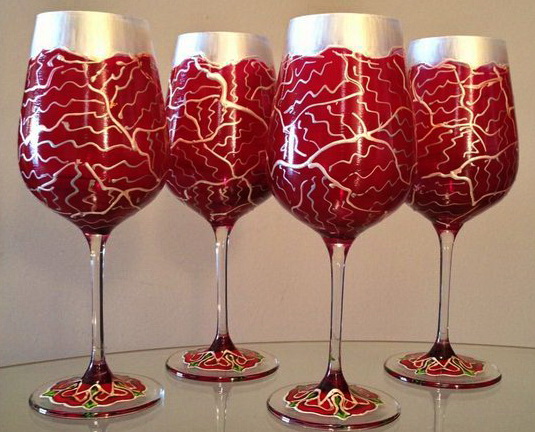
But there are much more showy glasses out there, and I hope some of the contestants will take advantage of them. Here’s an example:

hand-painted-wine-glasses-custom-valentines-day-tu--UDU2Ny0xMDAzMzIuMzI5NjIz

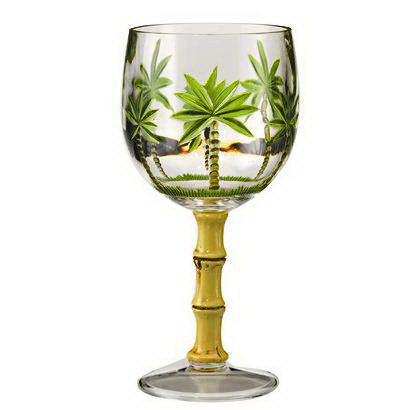
And here’s an idea for a less formal tropical setting:

10807342

C’mon guys and gals, try a little harder!

Footnote: A site called FlawlessVision  seems to specialise in sending up shows like these – it’s pretty funny but be warned: the language gets pretty rough at times.

$15 Leo Buring tops Riesling Tasting

The best surprises are cheap wines that shine like beacons

It was a tasting arranged by Gourmet Traveller Wine magazine, guided by Peter Bourne at Luke Mangan’s Mojo in Sydney’s trendy Waterloo. The wines served were:

  1. 2013 Pewsey Vale Prima Riesling.  Made in the Spaetlese (late-picked) style, therefore a little sweet, lovely integration and mouth feel, good on its own. 93 points. $22 at Dan M’s (online only)
  2. 2013 Pewsey Vale Eden Valley Riesling (the standard wine). Love this wine’s zest and life and fruit and drive, lovely line and length, ridiculous value. 94 points. $14.50 at Kemenys.
  3. 2013 Knappstein Handpicked Riesling. Clare. Third time I’ve seen this wine, and that flat spot at the end of the palate is still there. 91 points.
  4. 2013 Pikes Traditional Riesling. Polish Hill River. Third time I’ve seen this, and it’s still short. Nose full of limes and more on the tongue. 92 points.
  5. 2013 Skillogalee Riesling. Clare. Disappointing from the nose onward. Lacks fruit and lift on the palate, finish doesn’t leave you smiling. 86 points
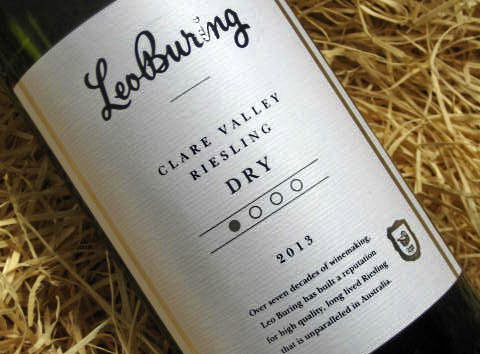
  6. 2013 Leo Buring Dry Riesling Clare Valley. Benchmark Riesling serving up fresh, fragrant limes and interesting minerals. Wonderful restraint and tension, great length and purity, the finish goes on and on. 96 points. $15 at Winelistaustralia. Just over $15 at Dan M’s.
  7. 2013 Leo Buring Leonay Riesling DWQ 18. Watervale. Great concentration and intensity of fruit here, but a touch short and hard on the finsih. 93 points. $31 at Dan M’s.
  8. 2012 Paulett’s Antonina Riesling. Lovely clean wine with fine structure, lacks depth of flavour. 91 points.
  9. 2012 Jim Barry The Florita Riesling. This has all the flavour you can ask for, and depth. A smorgasbord. 95 points. $38 at Dan M’s (online only).

LeoBuring_DryRies_Clare_13

The Leo Buring surprised me for another reason: I haven’t been wowed by the wines under this label these last few years. Not much more to add except that we’re blessed with the unpopularity of Riesling (Andrew Mitchell).

Kim

Alcohol on wine labels – a misleading number?

If you’ve read some of the articles on this site, you’ll know that strong opinions come easily to me. The rising alcohol levels in our reds is one topic that gets me going, but I check the alcohol on wine labels I’m thinking of buying for another reason: it tells me something about the wine, or so I thought until I became aware of what the article by Philip White cited below reveals.

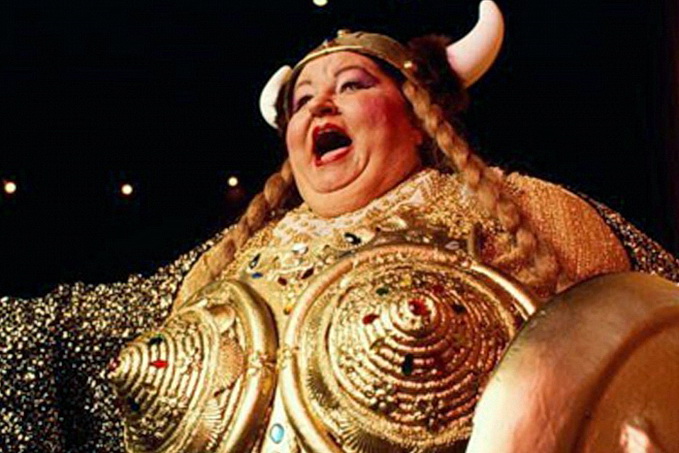
Simple example: I like my Chardonnays medium to full bodied, so when I see 12.5% on the label, there’s a good chance it’s going to be one of those new wave Twiggy grapefruit concoctions. If it says 13.5 -14%, I feel more comfortable. If it goes much higher than that, I’ll probably pass because the wine will be of Wagnerian proportions.

Opera

I’m talking about personal preferences here, not right or wrong. Same with Rieslings, only the numbers change: 12.5% is just about perfect in my book, but 12 – 13 is the sweet spot. I like some flavour and body in my Rieslings, along with the refinement they can ooze. 13% is about perfect for savvies – if it’s less, there’s a good chance you’re on an acid trip.

Reds are similar: Cabernet or Cab Merlot is perfect anywhere between 13 – 14%, and even with Shiraz or GSM I prefer not to go past 14 but will tolerate 14.5% for a good one. Dessert wines are a different subject because of the retained sugar.

All pretty simple until reality comes along, turns your table over and smashes your glasses. It turns out that wineries can go 1.5% of alcohol either way without breaking the law, which means all our carefully considered numbers go out the window. It does explain how certain winemakers produce wines with exactly the same alcohol levels, year after year, regardless of season.

Kym Teusner’s reds are a perfect example: since I first came across them, from the 2010 vintage, every single one of them I’ve seen has been 14.5%. When you see that kind of consistency, you can be sure that the winemaker can’t be bothered. As long as the alcohol level is between 13 and 16%, it’s all above board and legal. Many other wineries do the same thing.

So how do we wine lovers, drinkers and consumers work out if the alcohol level given on the bottle is real? If you see 11.7%, 12.3%, 12.8%, 13.4%, 13.8%, and similar fractions, you can be reasonably sure that they’re accurate. You can be even surer when the alcohol level on the label of a given wine varies from year top year. Yes, that’s about all I can tell you.

Black Snake slithers into alcohol debate

INDAILY, Philip White, February 11, 2014

Have you ever wondered why all the red wine in Australia is 14.5 per cent alcohol?

Don’t.

Because it’s not. It just says that on the labels.

In reality, many wines claiming that 14.5 figure are actually 16 per cent.  In making their alcohol claims, Australian winemakers are permitted an error margin of 1.5 per cent either side of the number they nominate.

MORE

It’s NOT what you Eat and Drink that Kills You

We’ve found a really simple answer to the diet/heart disease debate

The Japanese eat a diet very low in fat, and their rate of heart disease is about half that of America, Britain, Australia and New Zealand.

On the other hand, the French eat a lot of fat yet their rate of heart disease is around half that of America, Britain, Australia and New Zealand.

The Koreans drink very little red wine, and their rate of heart disease is about half that of America, Britain, Australia and New Zealand.

The Italians drink vast quantities of red wine yet their rate of heart disease is about half that of America, Britain, Australia and New Zealand.

The obvious conclusion is this:

Eat & drink what you like. It’s speaking English that kills you.

Ray Kidd – visionary CEO of Lindemans

Today I talked with Ray Kidd, one of the pioneers of the Australian wine industry in the post war years. Ray was born in 1926 and ran Lindemans from 1962 to 1986. He doesn’t sound like a man going on 90; the conversation was pretty lively from his end. Thanks to my friends Chris Anstee, Peter Bourne and Paul Ferman who suggested that I talk to Ray, and provided me with a contact number.

After writing a review of Ian Hickinbotham’s autobiography, and corresponding with him, I realised that we have very few of these icons left – I’m talking about wine industry greats who spanned the five decades from 1950 to the new millennium. Peter Lehmann died last year, Max Schubert has been  gone for 2 decades. I’d love to interview John Vickery who is in very good shape.

John Vickery

John Vickery is to Riesling what Max Schubert was to Shiraz down under. He made Rieslings in the sixties and seventies under the Leo Buring label that still serve as benchmarks today. Yes, some of them have lasted that long. John Vickery was a genius with Riesling but few people know that he made the reds for Lindemans’ Coonawarra operations from 1974 to 1980.

57 Varieties

In the nineties, with Lindemans sold to Heinz and CEO Ray retired, John was making Riesling for Richmond Grove. It used to be a Hunter Valley winery that was acquired by Orlando Wyndham who moved the cellar door to Chateau Leonay in the Barossa. John retired in 2005.

Anyhow, when I first spoke to Ray Kidd I discovered he wasn’t connected to the internet, nor did he have family members who were. I thought I’d better send him the piece I wrote last year: Lindemans – Death By a Thousand Cuts to give him an idea of where I was coming from. Ray said he was very comfortable with the overall thrust of the piece but wanted to correct a few details.

That meant he spent the first half hour of our interview today telling me the bits I’d got wrong. Sunshine vineyard wasn’t sold by the Philip Morris cost accountants, nor was Ben Ean. Sunshine was destroyed by floods, and some higher slopes of Ben Ean were sold to developers years later. The problem is that you rely on second hand reports when you weren’t there.

Ben Ean Moselle

The really interesting thing that came out of this talk with Ray Kidd was this: Lindemans was always a table wine company first, even in the dark old days of dingy wine bars serving cheap port to shady customers. Lindemans was making quality fortified wines at Corowa, but the bulk of its business was making table wine in the Hunter Valley. In 1950, they were the 11th biggest wine company in NSW according to Ray.

Then in 1953, Ray came upon the idea of Ben Ean Moselle. Hamilton’s Ewell was the model for that, a slightly sweet wine designed to move punters used to cheap fortifieds across to table wines. Ben Ean was a roaring success, and it was made from Semillon, Verdelho, white Muscat/Frontignan and whatever else was available at the time. Ray made the wine, and the wine made Lindemans.

As table wine became more fashionable, Lindemans found itself short of vineyards, so Ray bought Leo Buring in 1962, and then Rouge Homme in 1966, and some more land in Coonawarra which produced the Coonawarra Trio he is so proud of.

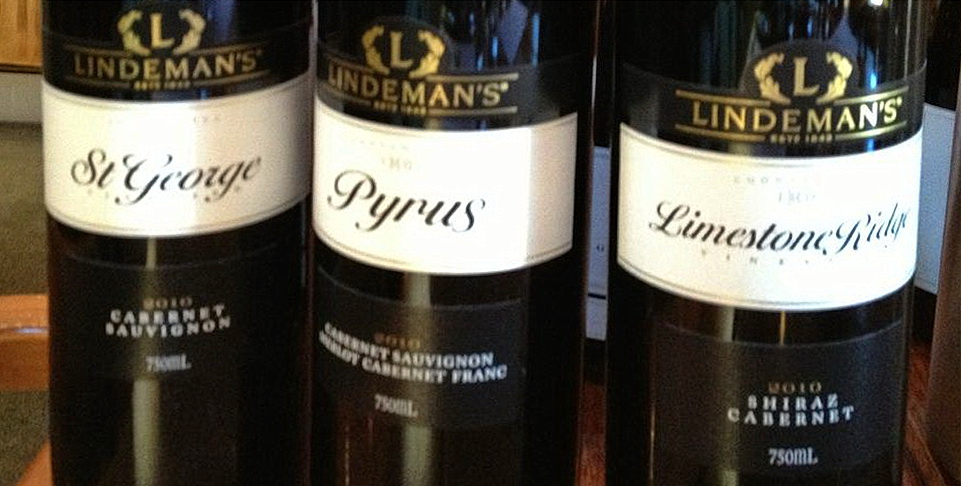
coonawarra trioAndrew Caillard writes that  ‘Lindemans Coonawarra Cabernet Sauvignon and Cabernet blends – St George Vineyard Cabernet Sauvignon, Limestone Ridge Vineyard Cabernet Sauvignon Shiraz and Pyrus Cabernet Sauvignon Merlot Malbec – were once regarded as the pinnacle of Coonawarra personality and prestige.

They were some of the first labelled single vineyard wines. However various factors including time, fashion and complacency have worked against their reputation. The globalisation of the brand name also has not really helped. The ‘Coonawarra Trio’, as they are now called, seem lost in such a commercially focussed portfolio. Indeed it is quite surprising they exist at all.’

Kim

Why we use street prices at BWU$20

Because it makes no sense to do anything else

A friend in the wine business said quoting street prices rather than RRP was unfair to the smaller merchants who couldn’t compete with the bigger ones. I disagreed and pointed out that:

·         The smart independents are no longer selling the same wines as the big guys (they focus on boutique wines and interesting imports)

·         Some have gone on line to grow their sales and reduce their overheads (and become more competitive)

·         Our lists of recommended wines show a strong representation of smaller merchants (online)

More >>