


The Real World
That’s where we live, not in the exalted sphere of $1000 bottles. That end of the market has little to celebrate as it turns out. In 2025, Treasury Wine Estates offloaded the last brands in their once vast collection/, among them Wolf Blass and Lindemans.
Lindemans was a powerhouse many years ago, with Karl Stockhausen making legendary wines in the Hunter Valley, and John Vickery doing the same in the Barossa. Ray Kidd was the company’s visionary CEO until it was taken over by Philip Morris. It ended up with Southcorp and then Carlton United Breweries who created TWE.
That was about a dozen years ago I think – that’s when I wrote Lindemans – Death By a Thousand Cuts. Michelle Terry was appointed to run the company, a surprising appointment. ‘I get very passionate about whatever I am working on,’ Terry told the media, ‘I just like creating things and thinking about how they will impact a consumer’s life, creating growth plans and then watching them deliver.’
Less surprising was that Terry pushed the company into irrelevance in record time.
Riding High
Wolf Blass was still going strong yet TWE decided that Penfolds alone was the cash cow that would shower fortunes on its shareholders. These last few years have seen the number of special bin wines explode from less than 10 to over 100.
‘Our strategy is a luxury-led growth strategy,’ the CEO told the press back in February, ‘through Penfolds and Treasury Americas – that is the real heart of this business now.’
More recently TWE announced that its export volumes were falling way short of the forecast. The headlines in the Australian says it all: ‘Treasury Wine’s board slept while management lost the plot. The winemaker behind the Penfolds brand lost its way through a growth-at-any-cost mentality, and without radical intervention investors will be paying for this for years.’
In February 2026, Penfolds announced half-year losses of $650 million. I scratched my head when I read that. I mean, how can you lose truck loads of money when you charge like the Light Brigade for your wines?
It does explain though why we’ve not seen the Penfolds marketing follies of old, such as the giant ampoule filled with 2004 Block 42 Kalimna Cabernet. It was a limited edition hand-blown glass ampoule and a bespoke glass plumb-bob that suspended the ampoule within a wooden Jarrah cabinet. Only twelve ampoules were made, individually numbered as you’d expect for such ‘a beautiful, thoughtful, unique objet d’art, designed to store wine in an ideal environment.’ The price? A$165,000. yes, that ‘s 6 figures.
‘The Penfolds Ampoule is not only a compelling work of wine art,’ the press release went on, ‘it also provides a truly memorable experiential and sensory engagement. When a decision is made to open the ampoule, a senior member of the Penfolds Winemaking team will personally attend a special opening ceremony for the owner (essentially your very own master-class). Anywhere in the world that is.
The last extravaganza in a long line of stunts that never came close to the ampoule’s impact was Penfolds Grange, the Musical. It’s my name for a $95,000 bespoke music cabinet with a valve amplifier and a Penfolds-branded turntable. Apparently Max was a music lover. Is that so? He’s been dead almost 30 years, and now someone remembered that he loved music?
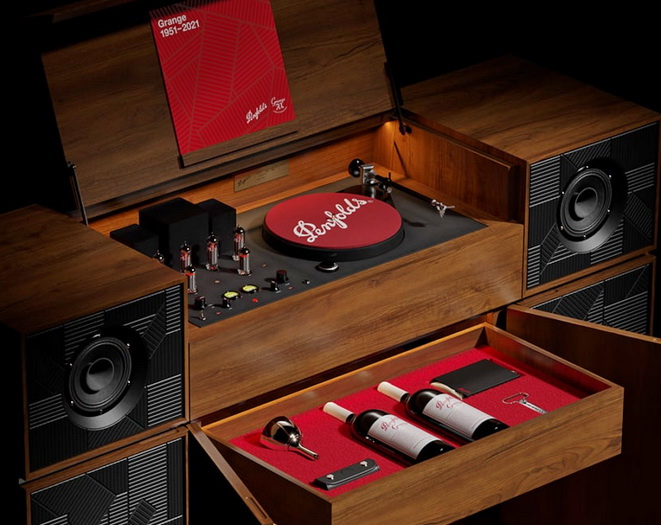
‘Only seven individually crafted pieces have been produced globally,’ says Penfolds, ‘paying homage to the “all in one” console design from the 1950s – the same decade Grange was first created by Max Schubert … Inside, wine lovers are welcomed by the rare “White Capsule” release Grange magnum duo of vintage 2010 and 2017. Hidden within the wine console compartment that also houses a suite of luxury accessories including a hand-blown Grange Decanter, crafted by leading Australian glass artist and designer, Nick Mount.’ More Here.
How we will miss these extravagant productions! What we get instead is new metal cannisters for the wines. How exciting! And new packaging for the year of the horse, which they screwed up because it’s the year of the Fire Horse that comes around every 60 years or so.
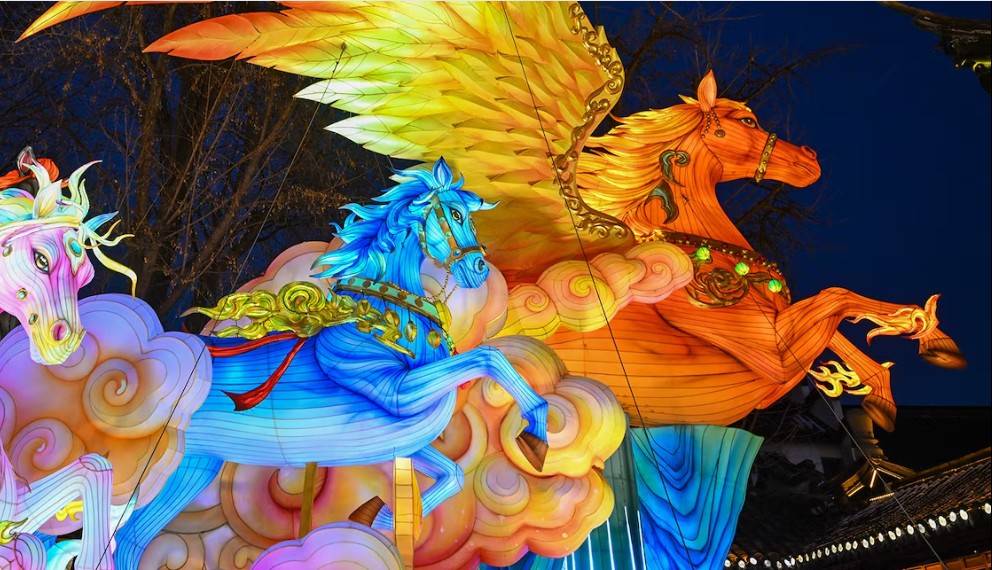
source: National Geographic
We also get Penfolds wines in the very fast lane – the company ‘has joined the 2026 Formula 1 Qatar Airways Australian Grand Prix as an event supporter. Across the four days at Albert Park Grand Prix Circuit in March 5-8, a selection of Penfolds wines will be served in premium hospitality venues including in the American Express Lounge.’ in 40 degree heat no doubt.

French accent, same story
Pernod Ricard had bought the venerable Orlando operation late last century and changed its name to Jacobs Creek. Last year, Pernod Ricard sold most of its international brands to Accolade Wines, another graveyard for established wine brands. PR’s new strategy was to focus on its spirits and champagne businesses, as the lower end of the wine market faced ‘challenges from economic uncertainty’.
Accolade was struggling to make ends meet despite a portfolio of strong brands that included Arras, Bay of Fires, Stonier, Petaluma, Croser, Hardy’s, Houghton and more. The company was owned by US-based Bain Capital, which merged the assets of Pernod Ricard with those of Accolade Wines to form Australian Wine Holdco Limited (AWL). Vinarchy was the commercial name chosen for the new set-up – we’re told that it combines ‘Vin (the French word for wine), with Archy (from the Ancient Greek word for leadership).’
Oh Mr Hart, such a mess!
Back Down to Earth
In this lucky country we’re blessed with a few wineries that live and breathe wine instead of fairy tales and balance sheets written in red. Wineries that produce excellent wines at fair prices.
Hill-Smith Family Estates is one of those, a family business that has acquired carefully selected wineries to its founding brand Yalumba. It’s Australia’s oldest family owned winery and it’s still a leading light. It put Viognier on the map in Australia, set up the country’s biggest vine nursery and makes wine using sustainable and organic practices.
The Sanctum Cabernet from Coonawarra is a great example of the kind of value the company offers. Pewsey Vale Riesling is another example – one of Australia’s finest Rieslings you can buy for $20. The Y series wines can be bought for less than $10, and they’ve been getting better and better. The Viognier and Pinot Gris are favourites, along with the Tempranillo.
Jim Barry Wines is another family business that makes great wines at fair prices. Early this year we were buying Barry & Sons trophy-winning Cabernet from Liquorland for $15. Their Watervale Riesling can be found for close to that price, and is always on song.
Leconfield / Richard Hamilton is the third family business in South Australia that overdelivers. The 2022 Merlot rewrites what we think of this variety down under, for $20 at DM’s where the vintage is a lottery, or $18 at Winedirect in a mixed dozen after 30% off with code PICKMIX, and free freight anywhere in Oz. It’s a $15 as a Hidden Label at Kemenys. Talk about the silly season!
If you prefer Cabernet to Merlot, the Leconfield Cab from the great vintage 2021 is just $2 more. You could be adventurous and blend the 2 wines. The Leconfield Cabernet Franc 2024 is a cracker as well, also under a Hidden Label for $17. The fruit fairly leaps out of the glass, with no new oak to get in the way. It’s all there, the berry fruit with a hint of mint, some gravel dust and a touch of tobacco leaf. Medium-bodied, perfect balance, a touch bigger than usual, and softer as well. No bad acid trip or harsh tannins to get in your way. 95 points.
Good for us but Not Good for Business
That wines of this calibre aren’t walking out the door and have to be sold at deep discounts is a big puzzle. Yes we have a wine glut but that shouldn’t affect our best and most longstanding wineries. One exception is Wynns who’ve made a string of wonderful Black Label Cabernets over many years that Penfolds would ask 2 or 3 times as much for.
Other wineries that overdeliver in South Australia are Bleasdale, Lake Breeze and Bremerton at Langhorne Creek, and Robert Oatley, Mitolo, d’Aremberg and Bellevue at McLaren Vale. There are too many others to name. South Australia offers the best value wines down under IMHO, often with impressive consistency.
The Clare Valley is an example, producing lots of great wines right in our sweet spot. Almost all the wineries are family owned here, and it shows. Jonathan Hesketh has entrusted John Vickery’s legacy to the very capable Keeda Zilm, and the Rieslings remain stunning bargains.
In Victoria we have Bests and Seppelt at Great Western, in the West the standouts for us are Rosily, Vass Felix and Xanadu. I can’t name them all here, just a few examples.
In NSW, Moppity has been making great wines for years, and these are often hidden or secret labels at Kemenys. Jason Brown really understands the secrets of aging reds in fine oak. Hunter wines rarely hit the right quality / price ratio, nor do the good wines of Orange. There was one exception in the run-up to Christmas: Brokenwood. Yes you read that right – can’t remember the last time we got excited about a Brokenwood wine for around $20. Or a Hunter Chardonnay.
It’s not a Hunter wine, it turns out. Brokenwood Chardonnay 2024 is a blend of 70% chardy from Beechworth, 20% from the Yarra Valley and 10% from the Hunter. Stored in French oak, 20% new. A classy, pitch-perfect Chardonnay of great finesse and that crystalline Beechworth purity. It sold for $25 at the winery earlier in the year, and later for $22 at Dan Murphy’s of all places.
The Right Merchants
Of course we couldn’t do what we’re doing without wine merchants who supply these wine at sharp prices. And as I showed in Don’t be Fooled – Everybody Beats Dan Murphy’s, the merchants we’ve selected leave DM’s choking on his empty claim. Where’s the ACCC when the truth is strangled like that?
The prices at MyCellars are sharp, and the freight is free for subscribers on any quantity. (promo code BWU20). The prices at Summer Hill Wine and Our Cellar are sharp, and the offering diverse. Winedirect offers lots of deals on pre-selected packs, and runs sales of up to 30% off shelf prices. One of these is running right now.
Kemenys offers sharp prices as well as hidden and secret labels that can save 30% or more on good quality wines. Reprinted reviews from wine scribes tend to make it easy to work out what wine is secret or hiding.
Same goes for Nicks in Melbourne and its diverse range of secret wines, which also provide hints in their labels. Nicks Secret HEW Barossa Mourvedre tells me that it’s made by Hewitson, and several reviews at the link will confirm it. The trick is not to enter the whole review into you search engine but just a couple of sentences that avoid the usual platitudes.
Nicks and Kemenys let you buy as many or as few of these bargain bottles, whereas Winestar’s secret wines are only sold in unbroken dozens. I bought a few of these over the last year and, despite careful selection, I’d say that about 1 in 3 cases were ordinary wines or worse. When you do the math, you realize that you paid close to full price for the good ones.
That’s enough chest-beating for one mailer I suspect. I wish you all a peaceful and joyful festive season with lots of good food and wine.
KIM